Best Pressure Canners for Home Canning (2026 Guide)
The two pressure canners worth considering for most home kitchens — and how to choose between them.
Disclosure: This post contains affiliate links. As an Amazon Associate, we earn from qualifying purchases at no extra cost to you. We only recommend products we believe are genuinely useful for home food preservation.
If you want to can low-acid foods like vegetables, meats, beans, and soups, a pressure canner is not optional — it is the only safe method recommended by the USDA. After reviewing the current market and comparing specifications, safety features, and real-world usability, two models stand out for most home kitchens: the Presto 01781 23-Quart Pressure Canner for stovetop canning, and the NESCO NPC-9 Smart Electric Pressure Canner for those who prefer an electric, set-and-forget approach.
This guide breaks down both options, explains how to choose the right one for your kitchen, and covers the safety fundamentals every pressure canner should know before their first batch.
Quick Comparison
| Feature | Presto 01781 | NESCO NPC-9 |
|---|---|---|
| Type | Stovetop | Electric |
| Capacity | 23-quart | 9.5-quart |
| Material | Heavy-gauge aluminum | Stainless steel |
| Best for | Beginners who want a reliable, USDA-recommended stovetop canner | Small kitchens and beginners who prefer automated canning |
| Pressure control | Manual (weighted gauge) | Automated |
| Works on | Regular and smooth-top ranges | Countertop (no stove needed) |
| Price range | ~$165 | Higher |
| Our rating | Best Overall | Best Electric |
Why Pressure Canning Matters
Water bath canning works well for high-acid foods — fruits, pickles, jams, and most tomato products with added acid. But low-acid foods (vegetables, meats, poultry, seafood, and legumes) require a different approach.
The reason is Clostridium botulinum, the bacterium that causes botulism. Its spores survive boiling water and only die at temperatures above 240°F (116°C) — which water bath canning cannot reach. A pressure canner raises the internal temperature above that threshold, making it the only USDA-approved method for safely canning low-acid foods at home.
If you are only canning jams, jellies, and pickles, a water bath canner is enough. But if you want to put up green beans, tomato sauce with meat, soups, or stews, you need a pressure canner. There is no safe shortcut around this.
Best Overall: Presto 01781 23-Quart Pressure Canner
Presto 01781 23-Quart Pressure Canner and Cooker
Best for: Beginners who want a reliable, USDA-recommended stovetop canner
- USDA-recommended method for low-acid foods
- Doubles as boiling-water canner for fruits and pickles
- Works on regular and smooth-top ranges
- Amazon's Choice
- Requires manual pressure monitoring
- Heavy when filled
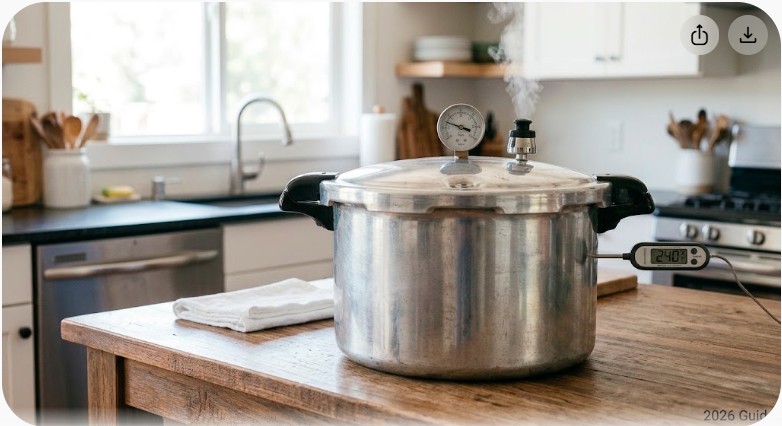
The Presto 01781 has been a standard recommendation in home canning circles for years, and for good reason. It is a stovetop pressure canner with a 23-quart capacity — enough to process 7 quart jars or 20 pint jars in a single batch. That capacity makes it practical for putting up a full garden harvest without running the canner all day.
It uses a weighted pressure regulator, which means you monitor and adjust the heat manually to maintain the correct pressure for your altitude. This is the traditional method, and it is what USDA-tested canning procedures are written around. If you are following a tested recipe, the Presto 01781 works exactly the way the recipe expects.
One useful detail: the same pot doubles as a boiling water canner for high-acid foods. If you are just getting started, this means you do not need two separate canners to cover both categories of food.
Who it is for: Beginners who want a single, reliable canner that handles both water bath and pressure canning, and who are comfortable monitoring pressure on a stovetop. It is also a solid choice for experienced canners who prefer the traditional weighted-gauge approach.
Who should look elsewhere: If you have a glass-top or induction range, check your manufacturer’s guidance first — large canners can be heavy and some stovetops are not rated for them. If you would rather not monitor pressure manually, an electric model may suit you better.
Best Electric: NESCO NPC-9 Smart Electric Pressure Canner
NESCO NPC-9 Smart Electric Pressure Canner
Best for: Small kitchens and beginners who prefer automated electric canning
- Electric — no stovetop needed
- Automated pressure and temperature control
- Compact for small spaces
- Smaller capacity than stovetop models
- Higher price point
The NESCO NPC-9 takes a different approach. Instead of sitting on a stove, it plugs into a standard outlet and manages pressure and temperature automatically. You set the process, and the canner handles the rest — no manual heat adjustments, no watching a gauge.
The trade-off is capacity. At 9.5 quarts, the NPC-9 holds fewer jars per batch than the Presto 01781. For small households or beginners testing whether pressure canning fits their routine, that is often fine. For anyone canning a large garden harvest, the smaller batch size means more cycles.
The stainless steel construction is a plus for durability and cleanup, and the compact footprint fits kitchens where a large stovetop canner would be awkward to store or use. Because it does not need a stove, it also works in kitchens with limited burners or rental kitchens where a large canner might not be practical.
Who it is for: Beginners who want a simpler, more automated introduction to pressure canning. Small kitchens, renters, and anyone who prefers a countertop appliance over a stovetop pot.
Who should look elsewhere: If you are canning in volume — a full garden, bulk meat purchases, or large batches of soup — the smaller capacity will slow you down. And if you already have a stovetop you like working with, the manual Presto may give you more control at a lower price.
How to Choose a Pressure Canner
Choosing between these two comes down to four factors.
1. Stovetop vs. electric
Stovetop canners like the Presto 01781 are the traditional standard. They are what USDA-tested recipes assume, they handle large batches, and they double as water bath canners. The trade-off is that you monitor pressure yourself.
Electric canners like the NESCO NPC-9 automate the process, which is genuinely helpful for beginners. The trade-offs are smaller capacity and a higher price.
2. Capacity
Think about how much you can at once. A 23-quart canner handles 7 quarts or 20 pints per batch. A 9.5-quart electric canner handles noticeably less. If you are canning a few jars at a time, either works. If you are processing a full harvest, capacity matters more than convenience.
3. Your stove
Not every stove is rated for a large canner. Glass-top and induction ranges in particular may have weight or size restrictions. Check your manufacturer’s guidance before buying a stovetop canner. Electric canners sidestep this entirely.
4. Your comfort with the process
Pressure canning has a learning curve. If you are new and nervous about monitoring pressure, an electric model lowers the barrier. If you are comfortable with the traditional process — or want to follow USDA recipes exactly as written — a stovetop canner is the better fit.
Pressure Canning Safety Basics
No matter which canner you choose, safety comes first. A few fundamentals:
- Follow tested recipes. Use current USDA or National Center for Home Food Preservation guidance. Do not adjust processing times or pressures based on family recipes or social media.
- Adjust for altitude. At higher elevations, you need higher pressure to reach the same internal temperature. Your canner’s manual will include an altitude chart.
- Never open a canner under pressure. Wait until the pressure has fully dropped and the canner has cooled before removing the lid.
- Check your equipment. Gauges should be tested periodically, and gaskets and seals should be inspected before each season.
- Vent properly. Most pressure canners require a steady stream of steam for 10 minutes before pressurizing.
These steps are not optional. Botulism is rare but serious, and pressure canning is the one preservation method where mistakes can be genuinely dangerous.
Frequently Asked Questions
Can I use a pressure cooker instead of a pressure canner? No. Pressure cookers and pressure canners are not interchangeable. Canners are designed to reach and hold specific pressures for tested processing times. Cookers are not built for that, and using one for canning is unsafe.
Do I need a pressure canner if I only can tomatoes? It depends. Tomatoes are borderline acidic, and most tested recipes add lemon juice or citric acid so they can be water bath canned. If you follow a tested water bath recipe for tomatoes, you do not need a pressure canner. If you are canning tomatoes with low-acid ingredients like meat, onions, or peppers, you do.
How much does a pressure canner cost? Stovetop models like the Presto 01781 typically run around $165. Electric models like the NESCO NPC-9 cost more, reflecting the added electronics and automation.
How long does pressure canning take? Processing time depends on the food and jar size — usually 20 to 90 minutes once the canner is pressurized. Add time for heating, venting, and cooling. A full batch can take two to three hours start to finish.
Can I use a pressure canner on a glass-top stove? Sometimes, but not always. Check your stove manufacturer’s guidance. Large, heavy canners can exceed what some glass-top ranges are rated for. Electric canners avoid this issue entirely.
Is a bigger canner always better? No. A larger canner takes longer to heat and cool, uses more stovetop space, and is heavier when full. If you can in small batches, a smaller canner may actually be more practical.
Final Verdict
For most home canners, the Presto 01781 23-Quart Pressure Canner is the best overall choice. It follows the USDA-tested stovetop method, handles large batches, and doubles as a water bath canner — making it the single most versatile piece of canning equipment you can buy.
If you prefer automation, have a small kitchen, or want to avoid stovetop canning entirely, the NESCO NPC-9 Smart Electric Pressure Canner is the best electric alternative. You trade capacity for convenience, but for beginners and small households, that is often a fair trade.
Whichever you choose, the important thing is to start with tested recipes, respect the safety fundamentals, and build from there. Pressure canning has a learning curve, but it opens up a category of food preservation that water bath canning simply cannot reach.
If you want to explore other essential harvest preservation techniques, check out our tested guide to the Best Vacuum Sealers for Garden Harvest or learn living probiotic preservation in Fermentation for Beginners. If you are still deciding between canning styles, our comparison of Water Bath vs Pressure Canning will help you choose the right approach for your harvest.
- Product note: When we link to preservation equipment or other products, those links may be affiliate links. Always check the current product specifications, price, availability, and manufacturer instructions before purchasing or using equipment.